Dropshipping Sales Funnels: Boost Your Conversion Rate by 20%
Anúncios
Dropshipping Sales Funnels: Boost Your Conversion Rate by 20%
In the competitive e-commerce market, especially in dropshipping, the difference between success and failure often lies in the efficiency of your sales funnel. In a dynamic digital landscape where consumers are increasingly demanding, having a well-structured, optimized dropshipping sales funnel isn’t just an advantage; it’s a necessity. This comprehensive guide will uncover the most effective strategies for creating and improving your funnels, with the ambitious goal of increasing your conversion rate by an impressive 20% in just 4 weeks.
Anúncios
The dropshippingmodel, by its nature, offers agility and low startup costs, but it also presents unique challenges, like building trust and standing out in a sea of competitors. A well-designed sales funnel acts as a map, guiding potential customers from their first contact with your product all the way to completing the purchase, and beyond. Let’s dive deep and discover how to turn visitors into loyal customers.
What Is a Sales Funnel and Why Is It Crucial for Dropshipping?
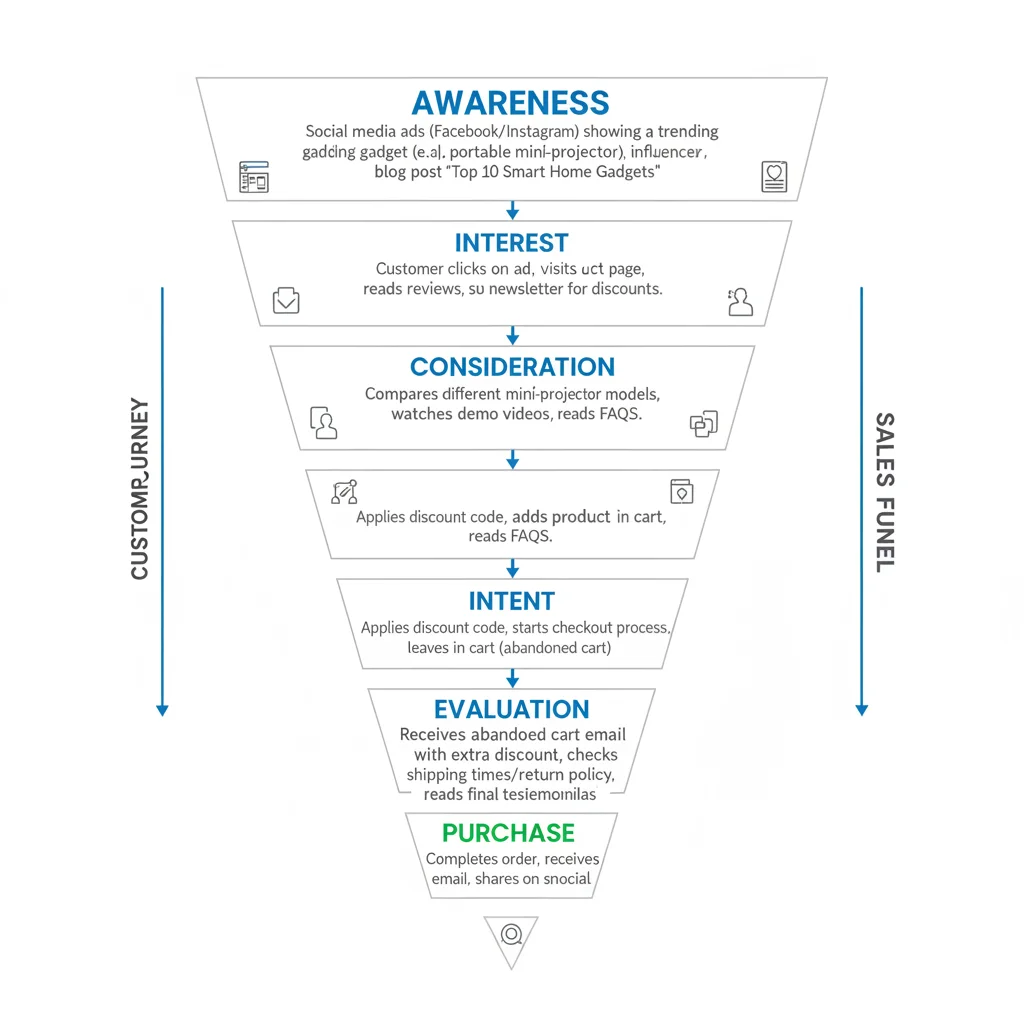
A sales funnel is a visual representation of the journey a potential customer takes, from the moment they become aware of your product or service to completing the purchase. In the context of dropshipping, where you act as the middleman between the supplier and the end customer, optimizing this path is even more vital to ensure a smooth, persuasive user experience that culminates in the desired conversion.
Anúncios
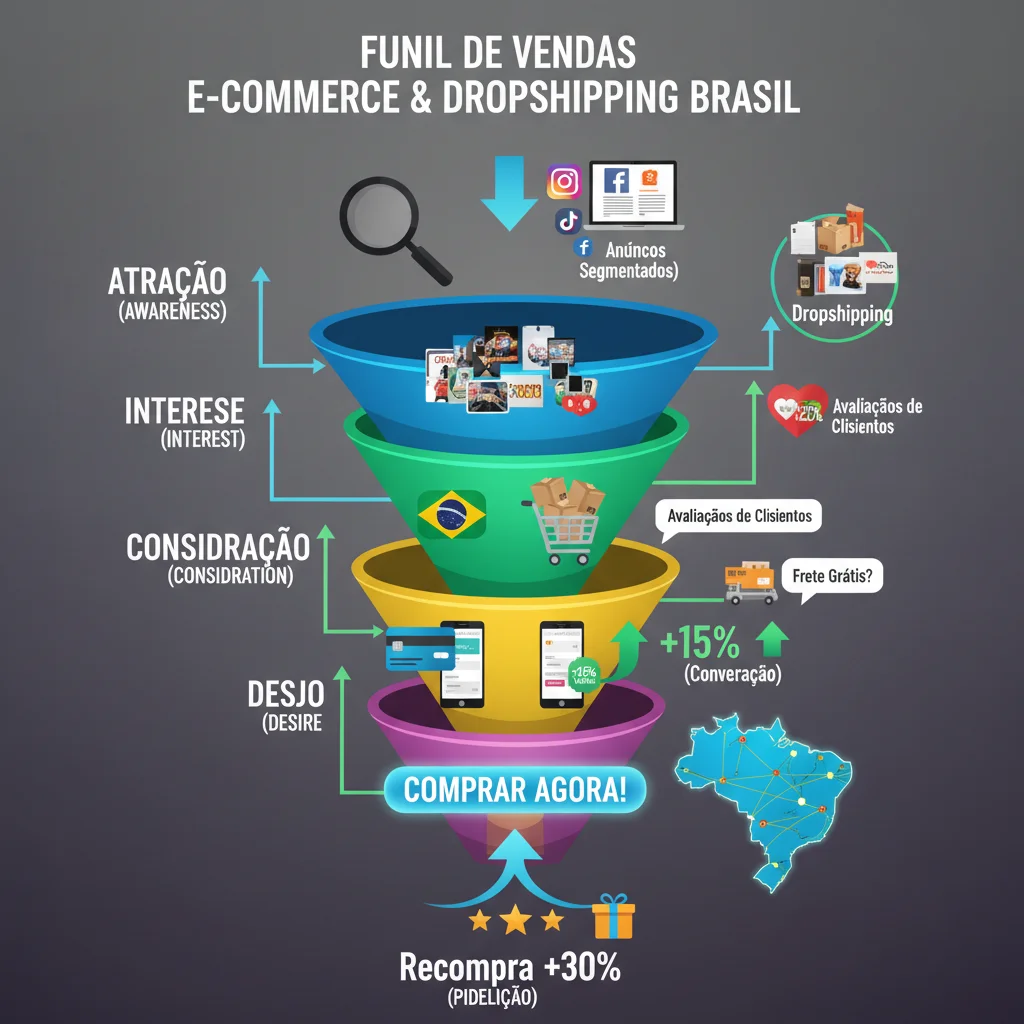
The Fundamental Stages of a Dropshipping Sales Funnel
Traditionally, a sales funnel is divided into stages: Top, Middle and Bottom. For dropshipping, we can break these stages down as follows:
- Awareness (Top of Funnel – ToFu): At this stage, the goal is to attract as many people as possible to your site or store. Users are just starting to identify a problem or need and don’t yet know your brand or products. Strategies like social media ads (Facebook Ads, Instagram Ads), SEO, content marketing (blog posts, videos) and influencer partnerships are crucial here. The idea is to generate qualified traffic and spark initial interest.
- Interest and Consideration (Middle of Funnel – MoFu): Once visitors reach your site, the goal is to keep them engaged and get them to consider your products as a solution. Here, you should provide more detailed information, demonstrate value and build trust. Well-crafted product pages, customer reviews, buying guides, demo videos and welcome emails are powerful tools. The goal is for customers to start comparing your offers and identifying with your brand.
- Decision and Action (Bottom of Funnel – BoFu): This is the final stage, where the customer is ready to make a purchase decision. Your role is to remove any remaining barriers and make the process easy. Special offers, free shipping (if applicable), a simplified checkout, multiple payment options (including digital wallets and buy now, pay later) and excellent customer support are decisive. The focus is on turning interest into an actual purchase.
- Post-Sale and Retention: An effective sales funnel doesn’t end at the purchase. The post-sale stage is crucial for building loyalty and encouraging repeat purchases. Follow-up emails, loyalty programs, exclusive customer offers and efficient after-sales support turn one-time buyers into repeat customers and brand advocates.
Strategies to Optimize Your Dropshipping Sales Funnel for Your Market
Every market has particularities you should consider when building your dropshipping sales funnel. Shopping culture, payment preferences and online behavior vary. Let’s explore the most effective strategies:
1. Top-of-Funnel Optimization: Attracting the Right Audience
- Precise Ad Targeting: Use ad platforms’ targeting tools (Facebook Ads, Google Ads) to reach your target audience based on interests, demographics and buying behavior. Understand your customers’ pain points and desires.
- Localized, Relevant Content: Create content that resonates with your audience. That includes language (informal but professional), examples and cultural references. Blog posts about trends, unboxing videos and tutorials can generate a lot of engagement.
- SEO for Your Target Market: Research relevant keywords and optimize your site for search engines. Consider regional search terms or slang your audience might use.
- Partnerships With Local Influencers: Digital influencers have immense power over purchase decisions. Find micro- and nano-influencers aligned with your niche and product to promote your items.
2. Middle-of-Funnel Optimization: Engagement and Trust Building
- Persuasive Product Pages: Your product pages need to be flawless. High-quality images, detailed and honest descriptions, videos of the product in use and clear delivery and return information are essential.
- Robust Social Proof: Shoppers place a high value on other consumers’ opinions. Display customer reviews and testimonials (with photos, if possible), security badges and quality certificates. This helps ease the distrust inherent in dropshipping.
- Educational and Comparison Content: Offer buying guides, product comparisons and articles that help customers better understand the solution you offer. This positions your store as an authority on the subject.
- Segmented Email Marketing: Capture visitors’ emails and send sequences that nurture the relationship, offer exclusive content and feature products related to the interests they’ve shown.
3. Bottom-of-Funnel Optimization: Maximizing Conversion
- Simplified, Transparent Checkout: A complex checkout process is one of the biggest conversion killers. Minimize the number of steps, offer guest checkout and be transparent about all costs (product, shipping, taxes).
- Multiple Payment Methods: Essential! In addition to credit cards, offer digital wallets like Apple Pay and Google Pay and buy now, pay later options. Not having these options can drive many shoppers away.
- Offers and Urgency: Use limited-time promotions, countdown timers and “only a few left in stock” notices to create a sense of urgency. Offer discount coupons for first purchases or abandoned carts.
- Free Shipping and Clear Delivery Times: Although dropshipping may involve longer delivery times, always be transparent. If possible, offer free shipping above a certain order value. Clear delivery times are essential to avoid frustration.
- Abandoned Cart Recovery: Implement a robust cart recovery system. Automated reminder emails, special offers or even a text or WhatsApp message can be very effective.
4. Post-Sale and Retention: Building Loyal Customers
- Follow-Up Emails: Send order confirmation and shipping tracking emails and, after delivery, ask for feedback on the product and the shopping experience.
- Loyalty Programs: Reward returning customers with exclusive discounts, early access to new products or points they can redeem for perks.
- Exceptional Customer Support: Good support solves problems and turns negative experiences into loyalty opportunities. Offer multiple contact channels (live chat, messaging apps, email) and respond quickly.
- Smart Upsells and Cross-Sells: Based on purchase history, offer complementary products or premium versions that add value for the customer.
Essential Tools to Optimize Your Dropshipping Sales Funnel
To build and optimize an efficient dropshipping sales funnel , you’ll need a few tools. Here are the main categories:
- E-commerce Platforms: Shopify, WooCommerce and BigCommerce are among the most popular and offer essential integrations.
- Marketing Automation Tools: ActiveCampaign, Mailchimp and Klaviyo for email marketing, funnel automation and CRM.
- Data Analysis Tools: Google Analytics, Hotjar (for heatmaps and session recordings) and the ad platforms’ own analytics.
- A/B Testing Tools: Google Optimize (free) or VWO to test different versions of pages and funnel elements.
- Ad Platforms: Facebook Ads (including Instagram), Google Ads and TikTok Ads to reach your audience.
Hypothetical Case Study: A 20% Increase in 4 Weeks
Imagine a dropshipping store specializing in smart home products. Before optimization, the store had a 1.5% conversion rate.
Week 1: Top-of-Funnel Analysis and Optimization
- Action: Analyzing Google Analytics data to identify the worst-performing traffic sources and keywords with a high bounce rate. Refining ad targeting on Facebook Ads, focusing on more specific interests (e.g., home automation, virtual assistants). Creating a blog post on ‘5 Essential Gadgets for a Smart Home.’
- Expected Result: Better traffic quality, attracting visitors more aligned with the product. A 5% reduction in bounce rate.
Week 2: Middle-of-Funnel Optimization
- Action: Improving product pages: adding demo videos, more high-resolution photos and more detailed, benefit-focused descriptions. Implementing an exit pop-up offering a free e-book on ‘How to Turn Your House Into a Smart Home’ in exchange for an email address. Adding more testimonials from satisfied customers and security badges.
- Expected Result: Longer time on site and a higher add-to-cart click rate. A 0.5% increase in conversion rate.
Week 3: Bottom-of-Funnel Optimization
- Action: Simplifying checkout to a single page. Adding digital wallets and interest-free buy now, pay later options as payment methods. Creating an abandoned cart recovery email sequence with a 5% discount in the first message. A/B testing different calls to action (CTAs) on the buy buttons.
- Expected Result: A 10% reduction in cart abandonment rate. A 1% increase in conversion rate.
Week 4: Post-Sale and Ongoing Analysis
- Action: Implementing a post-purchase satisfaction survey. Sending follow-up emails offering complementary products and asking for reviews. Continuously analyzing metrics at each funnel stage. Fine-tuning ad campaigns based on the results.
- Expected Result: Higher repurchase rate and customer satisfaction. Consolidating the conversion rate at 1.8% or more, a 20% increase over the initial 1.5%.
Key Metrics to Track in Your Dropshipping Sales Funnel
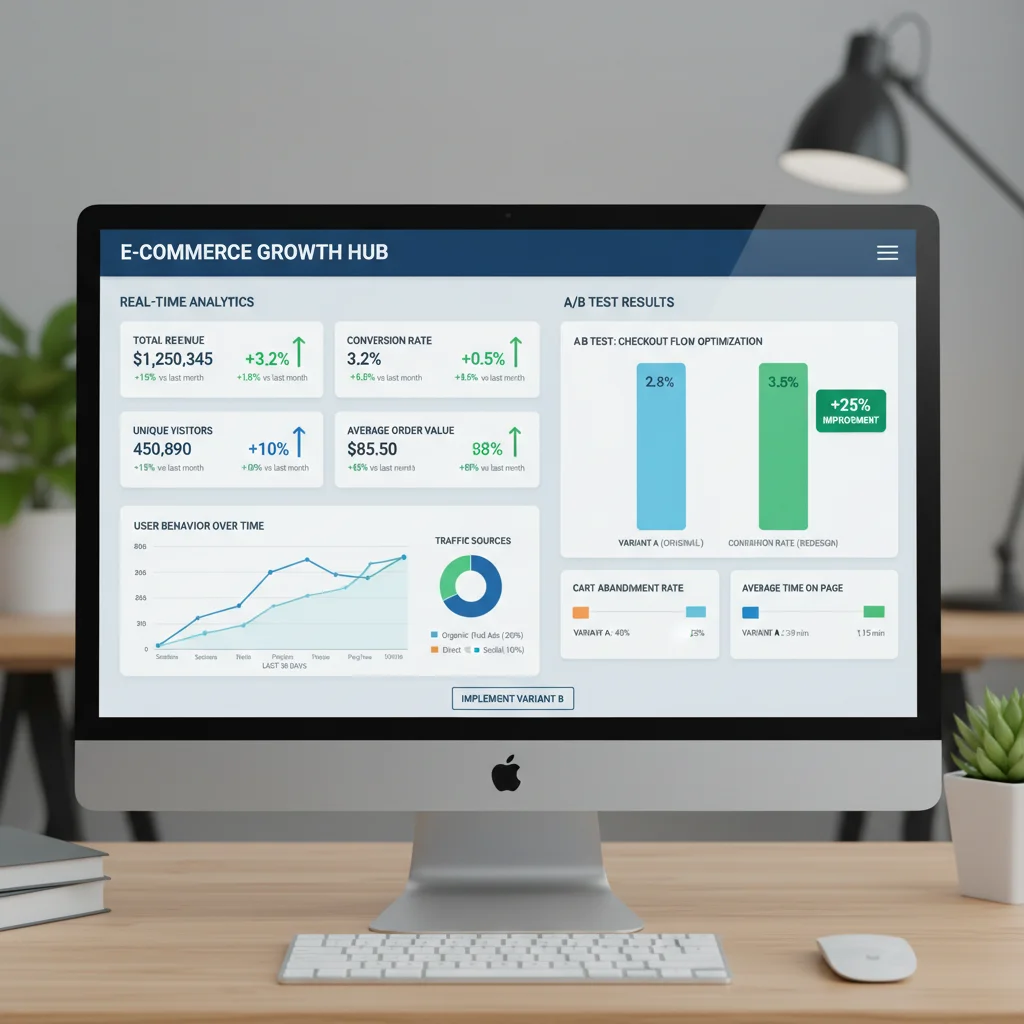
To know whether your optimizations are working, you need to monitor the right metrics. The most important ones for a dropshipping sales funnel include:
- Conversion Rate: The percentage of visitors who make a purchase. It’s the most important metric.
- Bounce Rate: The percentage of visitors who leave your site after viewing only one page. A high bounce rate at the top of the funnel may indicate problems with traffic targeting or content relevance.
- Cost per Acquisition (CPA): How much you spend to acquire a new customer. Optimizing the funnel should reduce this cost.
- Customer Lifetime Value (LTV): The total revenue you expect a customer to generate over their relationship with your brand. Good post-sale work increases LTV.
- Cart Abandonment Rate: The percentage of customers who add products to their cart but don’t complete the purchase.
- Average Time on Page: How long users spend on your product or content pages. It indicates engagement.
- Click-Through Rate (CTR): The percentage of people who click on your ads or links.
Challenges and How to Overcome Them in Dropshipping
The dropshipping market faces specific challenges that can affect your sales funnel:
- Long Delivery Times: Products imported via dropshipping usually have longer delivery times. Solution: Be transparent from the start, offer detailed tracking and, if possible, work with suppliers that offer ePacket options or U.S. warehouses.
- Consumer Trust: Distrust of online shopping is still a barrier for some people. Solution: Invest heavily in social proof, security badges, excellent customer support and clear return policies.
- Fierce Competition: The dropshipping market is saturated. Solution: Set yourself apart with a specific niche, innovative products, excellent customer service and a strong brand.
- Customs Issues and Taxes: Red tape and extra import costs can surprise customers. Solution: Be transparent about fees and taxes, if applicable, or include them in the final price to avoid surprises.
The Importance of Continuous Analysis and A/B Testing
A high-converting dropshipping sales funnel isn’t built overnight. It’s an ongoing process of optimization, analysis and testing. You should always be experimenting with new approaches, measuring the results and adjusting your strategies.
- A/B Testing: Test different ad headlines, product images, CTAs, product page layouts and email sequences. Small changes can produce big results in conversion rate.
- Heatmaps and Session Recordings: Use tools like Hotjar to understand how users interact with your site. Where do they click? Where do they stop? Where do they drop off? This information is gold for optimizing the user experience.
- Customer Feedback: Actively ask for feedback. Surveys, comment boxes and customer support conversations can reveal pain points in your funnel you hadn’t noticed.
Conclusion: Building an Unbeatable Dropshipping Funnel
Creating a high-converting dropshipping sales funnel is a journey that requires dedication, knowledge of your audience and a strategic approach. By focusing on every stage of the funnel – from attraction at the top to retention after the sale – and adapting your tactics to the particularities of your market, you’ll not only increase your chances of success but also build a sustainable, profitable business.
Remember that the goal of increasing your conversion rate by 20% in 4 weeks is ambitious but entirely achievable with the right strategies and flawless execution. Start applying these tips today, monitor your metrics closely and always be ready to test and optimize. Your dropshipping success is just one well-built sales funnel away!